-
Equality Insights Rapid Report: Solomon Islands Survey 2022
Equality Insights are proud to deliver this work in collaboration with representatives from government and civil society in Solomon Islands to ensure that the survey reached all areas of stakeholder engagement. Data was collected in every province using an innovative new phone-based survey to collect inclusive, multi-dimensional data about experiences of poverty and inequality in Solomon Islands in the wake of COVID19 disruptions.
-
Equality Insights Rapid Report: Tonga Survey 2022
This report presents new information about the situation of particular groups of people in Tonga and their experiences of poverty and inequality in relation to 15 key dimensions of life, against the context of disruptions linked to the COVID-19 pandemic and the events surrounding the volcanic eruption in 2022.
-
Equality Insights Rapid: Tool Development Report
Equality Insights Rapid is a survey and measurement tool to provide an improved evidence base for implementing COVID-19 recovery that advances gender equality. The tool has been developed for use in the COVID-19 context by providing a shorter survey that can be administered by phone, avoiding face-to-face data collection.
-

Count Me In! Card Game
Equality Insights developed and designed the ‘Count Me In!’ card game to demonstrate the importance of individual- level measurement to a non-data/technical audience. Through play, participants explore how measurement and visibility influences what is seen and unseen, in poverty data, prompting reflection on who is measured, what is measured and whose realities count. The card pack includes 30 person cards – giving players a character, 5 household cards which describe the location of the player’s home and 52 scenario or event cards, which each player responds to differently. The game is available online for download in Arabic, English, French, Khmer and Spanish.
-
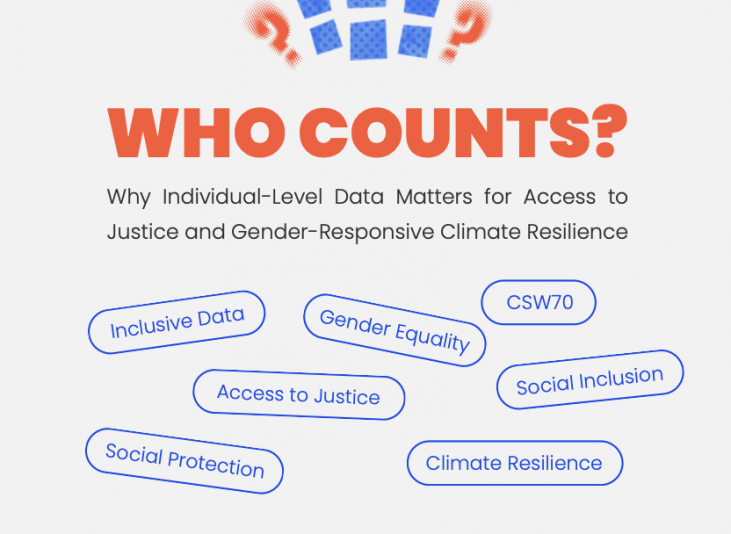
CSW70 Infographic: Why Individual-Level Data Matters for Access to Justice
This infographic explores why individual-level data matters for strengthening access to justice – the theme of CSW70 – and gender-sensitive climate resilience. A just-future – grounded in both gender and climate justice – requires robust and inclusive data systems, where everyone is counted and visible in the data that informs polices and decisions that affect their lives.