
You can’t change what you can’t see. How inclusive data accelerates action for gender equality.
Making sure everyone is counted matters more than ever as we move from International Women’s Day to Women Deliver.
“As an engineer I know how crucial data is for developing policies that service people not power. If we want to fight for a fairer, safer, better world, we must see where the gaps are before we can close them.” – Senator Mehreen Faruqi.
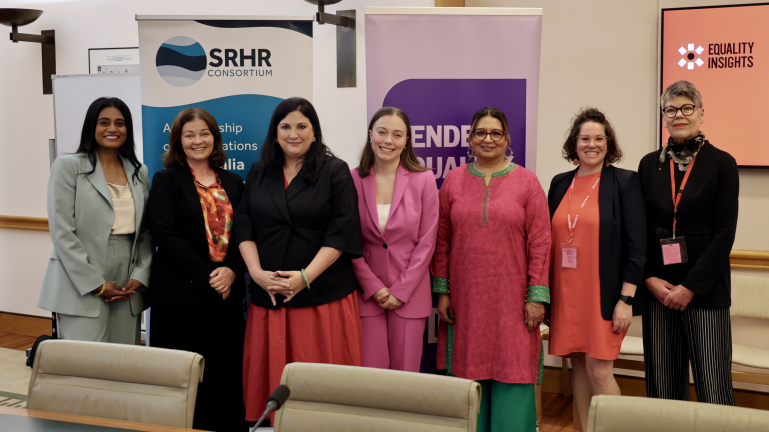
That was the powerful call to action from Co-Chair Senator Mehreen Faruqi as she opened the Equality Insights briefing for the Australian Parliamentary Friends of Population and Development (APGPD) International Women’s Day event at Parliament House last week.
Our position? Inequalities persist due to legacy data systems that exclude some lives by design. We need better, individual-level, gender-sensitive and inclusive data if we want to accelerate action for gender equality.

Inclusive data and evidence are antidotes to erosion of trust.
Open any news or social media channel, and one thing is clear – we are in a time of crisis, or what the World Economic Forum terms – a “poly-crisis”. Human Rights Watch calls it a “democratic recession” – with the number of democracies back to the level of 1985 and 72% of the world’s population now living under autocracy. Globally we know gender equality and rights are under attack and trust in systems and institutions is falling. Quick-spreading mis- and disinformation is only making things worse.
Trust in data underpins democratic decision-making. When official numbers fail to reflect lived realities, they don’t just leave people out, they actively erode the public’s faith in the systems meant to serve them. We need the data we use in decision-making to be fit-for purpose.
But as Equality Insights Director Jo Pradela shared with the room of parliamentarians and staff: “A lot of the data we’re currently using can only approximate, estimate or assume people’s circumstances.”
Inclusive data means counting everyone
Household surveys – the traditional backbone of poverty measurement – usually use one person (often a man) to speak for the entire household, which means one single respondent is a proxy for everyone else regardless of age, gender, disability, health, education, employment or other circumstances.
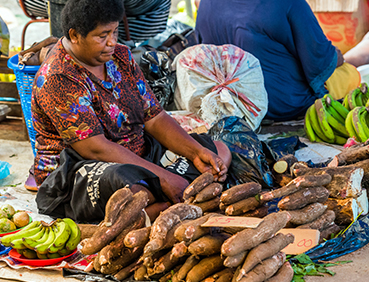
To bring this to life for the room, Equality Insights Strategic Advisor Jo Crawford shared real examples from Equality Insights surveys, including this one from Fiji.

If fuel exposure from cooking and heating is assessed at a household level, average daily exposure for a two-person household in the sample was 64 minutes per person. But as Jo Crawford emphasised, ‘this shows the reality of precisely no one.’ The Equality Insights survey revealed that in fact daily exposure for men was 24 minutes, and for women it was 105 minutes per day – more than four times as long, with flow on health impacts.
“This is why we developed Equality Insights. It generates data and evidence that can be used to support responsive, efficient and effective action that is connected to lived realities, contributes to equity and inclusion, and to people’s perceptions of fairness,” Jo Crawford explained.
Equality Insights as a tool for change
The team walked through some of the ways Equality Insights can support efforts across sectors:
- Individual circumstances, not household averages, should drive social protection program designs. Equality Insights generates the individual-level evidence needed to build targeted, responsive systems – a case we’ve made to the G20 and Australia’s Joint Standing Committee inquiry on gender equality.
- As the only multidimensional poverty measure we’re aware of that includes time-use as a specific dimension, Equality Insights helps illuminate links between the care economy, women’s poverty and women’s economic opportunity.
- The Belém Gender Action Plan adopted at COP30, positions gender data as integral to climate action. Equality Insights data can help us ensure climate action responds to real needs, taking account of gendered vulnerabilities and resilience. The Equality Insights team is collaborating with the UTS Institute for Sustainable Futures to increase visibility and awareness of inclusive measurement tools, and strengthen sustainable development and climate adaptation.
- Australia requires every aid program over $3 million to have a gender equality objective. Equality Insights data can support targeted development assistance. If we had a corresponding commitment to ensuring inclusive data was collected and available, development partners would have access to ready-built insights into where effort can deliver greatest gains. And we know from policy makers in partner governments that this data supports them to act and advocate.
- Lack of individual-level data has been identified by national governments across the region as a foundational constraint to meeting and reporting on global commitments such as the Sustainable Development Goals, CEDAW and other human rights conventions. Working with governments to support collection and use of individual-level data, Equality Insights makes sure everyone is counted accurately and clearly.

Members of the APGPD asked about the risks of misinformation with the pervasiveness of AI and the under-resourcing of data and statistics more broadly.
‘AI fishes in the existing pond of data. If this data isn’t accurate, or is missing altogether, AI will only amplify the problem’ Jo Crawford said.
Under-resourcing is an issue across the data landscape. “But if we only maintain resourcing for current systems and the status quo then we will find ourselves in a data future that remains unequal by default, even if not by intention.” Jo Pradela added.
Now is the time to double down on inclusive data
When people are invisible in data they are invisible in policy. The individual-level, gender-sensitive, multidimensional data that Equality Insights provides supports policy makers and advocates to make the case for resourcing gender equality investments.
With Women Deliver bringing more than 6,000 women’s rights activists and leaders from around the world to Narrm/Melbourne Australia next month, now is the moment to double down on establishing individual-level and gender-sensitive measurement as the standard, with the funding to support it.
Equality Insights is supporting calls for Australia to proudly step up and announce a doubling of the Gender Equality Fund. The team shared this call with the APGPD representatives to support resourcing that better aligns with Australia’s commitment to gender equality, moves us towards inclusive, individual-level data as the norm, supporting action that makes rights and justice a reality.
Equality Insights Director Joanna Pradela and Strategic Adviser Joanne Crawford joined APGPD to mark International Women’s Day on Wednesday 11 March at Parliament House joined by APGPD Co-Chairs Senator Mehreen Faruqi (Senator for New South Wales) and Dr Carina Garland Member for Chisholm; as well as Lisa Chesters Member for Bendigo, Ash Ambihaipahar Member for Barton, Senator Charlotte Walker (Senator for South Australia). We were also joined by staff from the offices of Dan Repacholi Member for Hunter, Senator Larrisa Waters (Senator for Queensland) and Melissa McIntosh, Member for Lindsey and Shadow Minister for Women.
Comments