
Protected: When gendered poverty remains invisible, justice is not possible.
By Jo Crawford, AM
With gender equality and reproductive rights under attack, what does it mean for women’s poverty and justice?
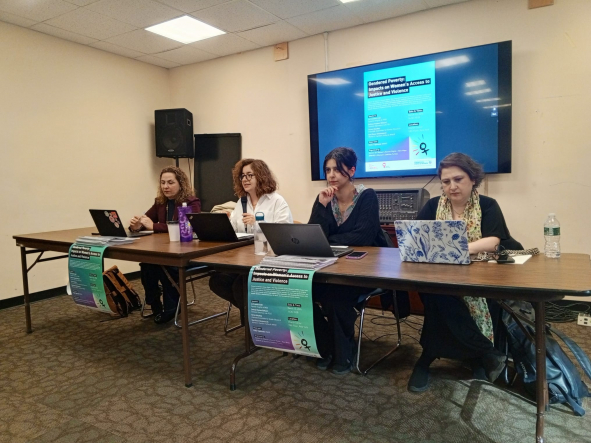
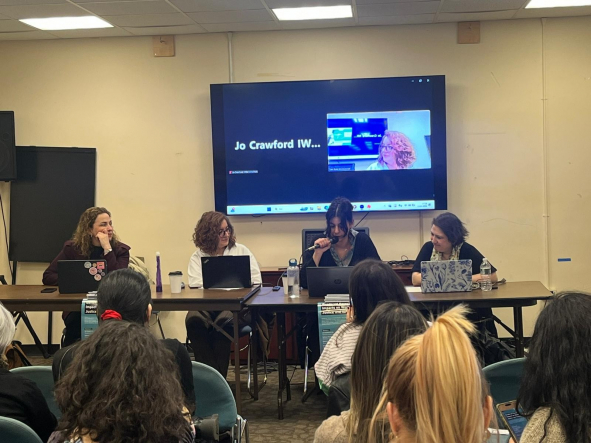
This was the conversation I joined at a parallel CSW70 event hosted by Women for Women’s Human Rights (WWHR) with feminist leaders from Turkey and around the world, moderated by Yıldız Taghızade from WWHR.
It was an impressive gathering of thinker-activists. My fellow panelists Şehnaz Kiymaz Bahceci, founder of the Feminist Diplomacy Lab, Dr Ceren Akçabay, Faculty of Law at Istanbul Okan University and representing the Aramızda Association for Gender Studies, and Ezel Buse Sönmezocak, Advocacy Coordinator at WWHR and part of the Women’s Coalition Turkey, shared learnings from their research, recent developments, and what this means for access to rights and justice in a context of pushback.
Here are my top takeaways:
1. The domestic care burden is ‘exploding’. In Türkiye, and other places, it’s by design.
Ceren Akçabay from the Aramızda Association for Gender Studies shared her research linking care work, social protection policies, and gendered poverty in Türkiye. She emphasised that:
- The ‘protection of the family’ narrative in Türkiye isn’t just a social discourse; it’s a deliberate economic strategy to shift social care costs onto women, deepening gendered poverty through institutional neglect. And it’s resulted in an explosion of the domestic care burden born by women.
- This framing of the family is a key way that authoritarian anti-gender narratives are becoming pervasive, positioning motherhood as a national duty, and women’s natural role. Family policy is being used as a strategic tool for political legitimacy.
- Information about the implications is hard to track. Limited routine data about poverty and inequality that provides insight into circumstances inside households is part of the problem – globally.
2. Gendered poverty is a structural condition that determines whether justice is practically possible.
Ezel Buse Sönmezocak, a lawyer and feminist activist with the Women’s Coalition Turkey and WWHR, shared research reviewing 30 local governments and their approach to the economic and social guarantees that underpin gender equality.
She found that while equality units often exist, they are typically small units within social services departments, rather than part of dedicated women’s machineries or gender equality teams. The focus is mainly on service delivery rather than addressing the deeper systemic roots of inequality.
“Legal rights alone are not sufficient. Economic, social and normative factors influence whether rights can be realised in practice.”
If municipalities want to move beyond charity, they need to invest in care services, shelters, and integrated and comprehensive support mechanisms. But there seems limited political will for this.
Ezel underlined that legal rights alone are not sufficient. Economic, social and normative factors influence whether rights can be realised in practice.
For instance, time poverty associated with responsibilities for both unpaid and paid work, and the financial implications when more of the total work burden is unpaid, limits options for women wanting to leave violence.
3. Both sex and gender need to be counted in when assessing costs, not defined out.
Two contributions on period poverty from event participants underscored this point.
İlayda Eskitaşçıoğlu Karavelioğlu, UN Young Leader for the SDGs and co-founder of Konuşmamız Gerek Derneği, a youth-led organisation focused on period poverty, spoke about the implications of menstruation that are not reducible to purchasing power. She emphasised the limitations of framing menstrual hygiene management as an individual issue for women to manage, rather than a reality and substantial economic cost for half the population for a substantial part of their lives.
“If we want to dismantle the structural barriers to justice, we need to
more deeply understand gendered poverty.”
Rhoda Reddock, CEDAW Committee member from Trinidad and Tobago, followed up, speaking about the overlap between period poverty and gendered poverty, noting that menstrual products don’t make it into emergency supplies after natural disasters such as hurricanes. She also underlined the implications of period poverty for girls’ education, which further amplifies gendered poverty.
If we want to dismantle the structural barriers to justice, we need to more deeply understand gendered poverty, and understand the interactions between multidimensional disadvantage and financial circumstances.
4. Current dominant approaches to poverty measurement invisiblise gender. But alternatives now exist that make change possible.
This is where I focused my contribution to the discussion. COVID-19 resulted in the first rise in extreme poverty in a generation, but standard poverty data couldn’t tell us who was most impacted – how many were women, how old they were, whether they had a disability, which made it difficult to effectively focus efforts to address risks and provide social protection.
Legacy systems and routine poverty measurement still assess poverty at the household level, which limits what you can see, even if you disaggregate data.
And they focus on money or a narrow range of factors when people with lived experience say many things keep them poor, and not all of these can be fixed with money.
Additionally, global poverty estimates that use widely available data sets such as the Demographic and Health Survey and the Multiple Indicators Cluster Survey are completely missing information about women over 50 – a cohort that experiences the cumulative impact of disadvantage and discrimination. This is a problem for both inclusion and accuracy.
“Legacy systems and routine poverty measurement still assess poverty at the household level, which limits what you can see,
even if you disaggregate data.”
This is not a new concern.
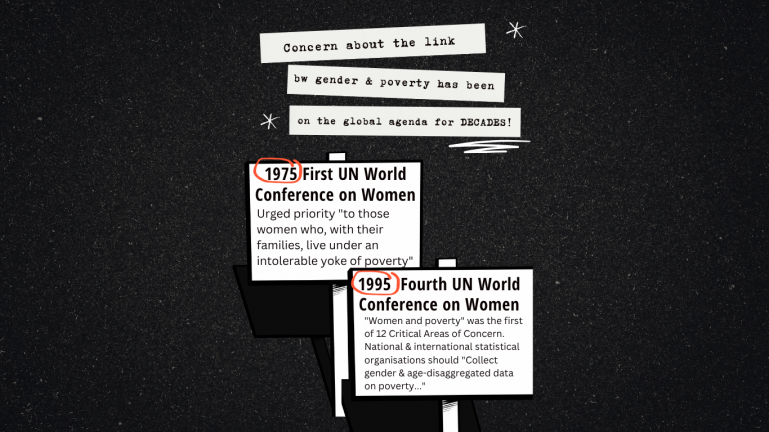
The 1995 Beijing Declaration and Platform for Action underlined that what is measured needed to change, to better capture disparities in economic power, remunerated and unremunerated work.
Agenda 2030, the Sustainable Development Goals framework and its focus on leaving no one behind underscored the need for individual-level data on poverty, including insights inside households.
But lack of an alternative methodology to measure poverty at the individual level functioned as a constraint to change.
Feminist leadership, rigorous research and testing through use, and support from champion governments, some multilateral organisations and philanthropy, has delivered a technically feasible, robust, individual-level measure of multidimensional poverty, that improves measurement accuracy and coverage, and reveals insights hidden by household-level measurement, including within households.
Equality Insights is the only multidimensional measure of poverty that we’re aware of that includes time-use as a specific dimension, alongside unpaid and paid work, and dimensions such as water, food and energy that help illuminate links between the care economy, women’s poverty, women’s economic opportunity and justice, and practical investments that could make a difference to the time available to women to improve their financial circumstances.
“Feminist leadership, rigorous research and testing through use… has delivered a technically feasible, robust, individual-level measure of multidimensional poverty.”
Equality Insights also integrates questions about how often the respondent has enough sanitary products to meeting their menstrual needs in the Sanitation dimension, and access to a private place to wash and change in the Shelter dimension.
5. Cross-movement action and collaboration is how we fight for a gender equal future. And having evidence and data to support this work is crucial.
Feminist leadership is vital to expanding the political space and pathways to prioritise data and evidence that illuminates differences inside the household, and normalise individual-level, gender-sensitive measurement of poverty that helps to reveal barriers and how these are influenced by gender, age, disability and other characteristics.
Şehnaz Kiymaz Bahceci from the Feminist Diplomacy Lab brought the global context into focus. In a moment defined by anti-rights mobilisation and spending that prioritises militarisation over wellbeing, the infrastructure that gender equality requires is being actively weakened.
She noted as an example that the UN Committee that oversees the Convention on the Elimination of all forms of Discrimination Against Women (CEDAW) only met twice this year rather than the usual 3 times.
“As responsibility for moving the needle is falling more heavily than ever
on feminist movements, we need to work together strategically
and support each other to drive change.”
Şehnaz also spoke about the proposed merger of UN Women and UNFPA, which not only threatens to shrink the space for organising but takes the focus on gender – which is supposed to be mainstreamed across the UN system – as evidence of redundancy and overlap.
She underlined the importance of wider conversations on financing for development and noted with concern the current emphasis on ‘real politik’ by decision makers – accepting the world as it is rather than using multilateral systems to seek accountability for commitments to address inequalities and support realisation of rights.
As responsibility for moving the needle is falling more heavily than ever on feminist movements, we need to work together strategically and support each other to drive change, and unfortunately we see many donors and funders pausing their investments into these movements at a time of heightened need to counter the regressive forces of militarization, macroeconomic inequalities and antigender mobilisations.
In times of political rupture, with armed conflicts driving multiple and reinforcing costs – increased violence, unproductive military expenditure, diversion of financial resources from other expenditure priorities, active undermining of multilateralism, increased costs of living, damage to the environment and unprecedented people movements – it can be tempting to focus on protecting the status quo. To focus all our energy on stopping things from getting worse, rather than investing in systems change to underpin more gender-responsive action.
But if we only fight to retain what we have now – legacy systems that have structurally prevented women and gender diverse people from accessing justice and equality – we will extend the long shadow of inequality, make it more difficult to see and address lived realities, and further erode trust that democratic systems can deliver for people.
Progress towards the world we collectively envisioned more than three decades ago is possible.
It looks like designing solutions based on data and evidence that counts everyone, that recognises care work, that includes the experiences of older women and people living with disabilities and that builds up understanding of what is happening from individuals, rather than households.
At CSW70, joining a room full of people refusing to accept the status quo, I was reminded that change requires both tools and the political will. We’ve created the tool – Equality Insights helps make visible the gendered experiences of poverty. With powerful feminist leadership and a growing coalition that understands that all of these issues are connected, we are building that political will together.
For more, read IWDA’s statement to CSW 70 on the inclusion of lived realities in data and evidence as a foundation for equity and justice – in English and other languages.
Comments